1. Leak rate turns tightness into a number
Q = Δp·V/Δt. A 1 m³ vessel changing 1 Pa in 1 s carries 1 Pa·m³/s. For scale: a 4 L bicycle inner tube losing 1 bar over 30 days is 1.5×10⁻⁴ Pa·m³/s; a refrigerator leaking 10 g of R134a over ten years is 7.1×10⁻⁷. The refrigerator is two orders tighter than the tube and still far from a semiconductor chamber.
2. Pressure rise measures more than leakage
With the valve closed, the rising pressure contains real leakage plus wall outgassing. Water outgassing decays as 1/t, approximately 3×10⁻⁹/t (hours) in mbar·L/(s·cm²). A freshly cleaned chamber can outgas several orders above its true leak for hours, so the reading is outgassing, not leakage, unless the background is measured and subtracted first.
3. Units differ by a factor of ten
1 mbar·L/s = 0.1 Pa·m³/s. Reading 1.5×10⁻⁴ Pa·m³/s as 1.5×10⁻⁴ mbar·L/s relaxes the requirement tenfold. Units in a contract matter more than the instrument model.
4. Temperature is not in the formula
Q = Δp·V/Δt has three quantities and no temperature term; the source material neither discusses temperature effects on pressure rise nor provides a correction (not covered). Any claim of temperature compensation should come with the formula.
5. Why helium testing reaches 10⁻¹³
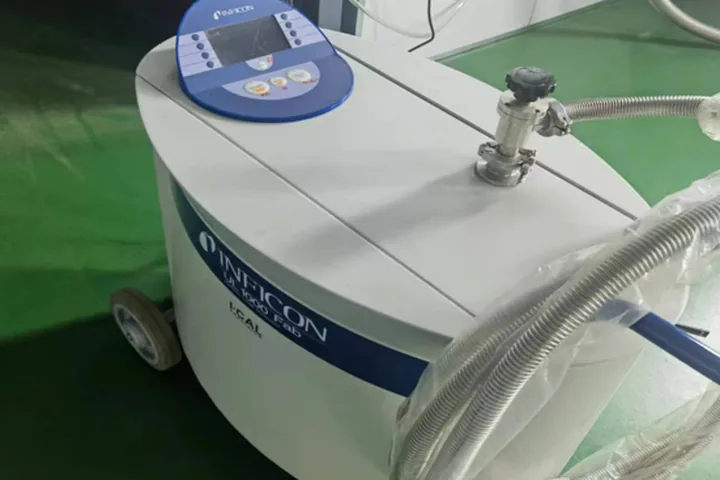
The mass spectrometer must operate below 10⁻⁴ hPa, maintained by the instrument's own pumps. The turbopump compresses air far more than light gases, so air is held back while helium passes — it acts as a selective filter rather than a pump. Counterflow covers 1 to 10⁻⁹ Pa·m³/s and dominates production use; main flow is more sensitive but needs 10⁻² hPa on both specimen and instrument. A quartz-window variant uses a 7 µm SiO₂ membrane with a 5×10⁻⁹ detection limit.
6. What each method can reach
Spray helium outside an evacuated specimen: < 5×10⁻¹³ Pa·m³/s at a 1000 hPa differential. Sniffing a pressurised specimen: < 1×10⁻⁸, specimen must withstand overpressure. Accumulation: mainly above 1×10⁻⁵, and slow. For a 10⁻⁹ verdict only vacuum-mode mass spectrometry qualifies; sniffing is floored by the 5 ppm helium naturally present in air.
7. Large chambers test slowly
In molecular flow (< 10⁻³ hPa) speed is set by specimen volume and effective helium pumping speed; above 1 hPa, laminar flow puts the backing pump in charge and everything slows. Longer waits on large chambers are geometry, not operator error — plan the response time into the schedule.
8. Three sources of misreading
5 ppm atmospheric helium; helium dissolved in oil-sealed backing-pump oil diffusing back into the high-vacuum side (open the gas ballast after a large leak); and no purge after a strong signal.
9. How we do it
Helium mass spectrometry against the criterion agreed on the project drawing. The capability we publish is the 1×10⁻⁹ Pa·m³/s range, with every unit tested rather than sampled. The method references GB/T 36176-2018 and GB/T 32218-2015, and the report is dispatched with the chamber. Pressure-rise testing is not used as an acceptance criterion here for one reason: it cannot separate leakage from outgassing, nor account for temperature error. For process judgement and rough localisation it remains entirely adequate; the sheet that gets signed calls for helium.
Leak testing is a verdict, not a step. A verdict that cannot be stated precisely makes the report meaningless. The same verdict applies to your project once a drawing is submitted.
FAQ
压降法能代替氦检吗?
做过程判断可以,做验收判据不行:压降法分不清漏与出气,也没有温度修正项。要签字的那张纸,得用氦检。
氦检能做到什么量级?
真空法外部喷氦可到 5×10⁻¹³ Pa·m³/s 量级;我方出厂检漏按项目图纸判据执行,对外披露的能力是 1×10⁻⁹ Pa·m³/s 量级。
为什么大腔体检漏要等很久?
分子流区(<10⁻³ hPa)响应时间由试件容积与对氦的有效抽速决定(V/S);进入层流区(>1 hPa)后由前级泵抽速决定,腔体越大越慢。